SaaS / AgTech / Operations
Agralon
A business operating platform designed for agricultural drone service companies.
- Status
- In production · beta
- Origin
- Kunz venture · in-house product
- Visit
- agralon.com
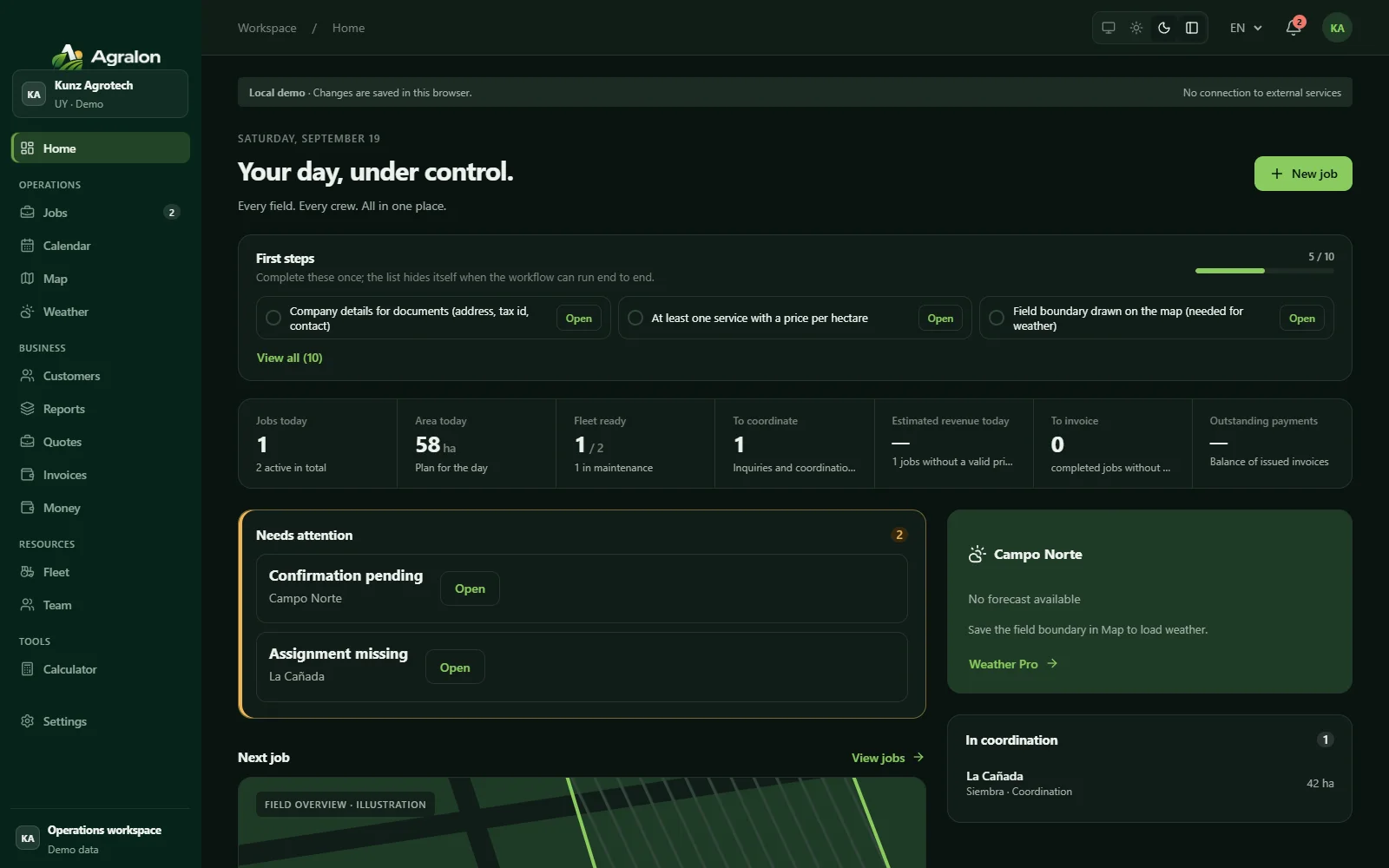
Interface shown with demo data
01 / Overview
One platform for the whole working day of a drone service company.
Agralon covers the complete operation of an agricultural drone service provider: from the first customer inquiry to the paid invoice. It combines a web workspace for the office with a mobile app for pilots in the field.
The product was born inside the Kunz group, which operates agricultural drones in Uruguay. We built the system we needed ourselves — and then built it properly, as a multi-tenant SaaS product for the industry.
Core capabilities
What this project proves
02 / The challenge
A young industry running on WhatsApp, paper and memory.
Drone service companies coordinate customers, fields, pilots, machines, products and weather windows — mostly through messages and spreadsheets. Generic business software knows nothing about hectares, application rates or flight conditions.
The work also happens where software usually fails: in the field, on a phone, often without a connection.
- Jobs agreed by message and lost in chat history
- No shared view of who flies where, with which machine
- Weather decisions made from consumer apps
- Reports and invoices written by hand after long field days
03 / The approach
Model the real workflow, end to end.
We designed Agralon around one chain: customer → farm and field → job → assignment → weather → execution → report → invoice → payment. Every screen serves a step in that chain, and each step hands its data to the next.
Roles are part of the model. Owners see the business, pilots see their assigned work, and financial data stays with the people responsible for it — enforced on the server, not just hidden in the interface.
04 / The product
An office workspace and a field app on one backend.
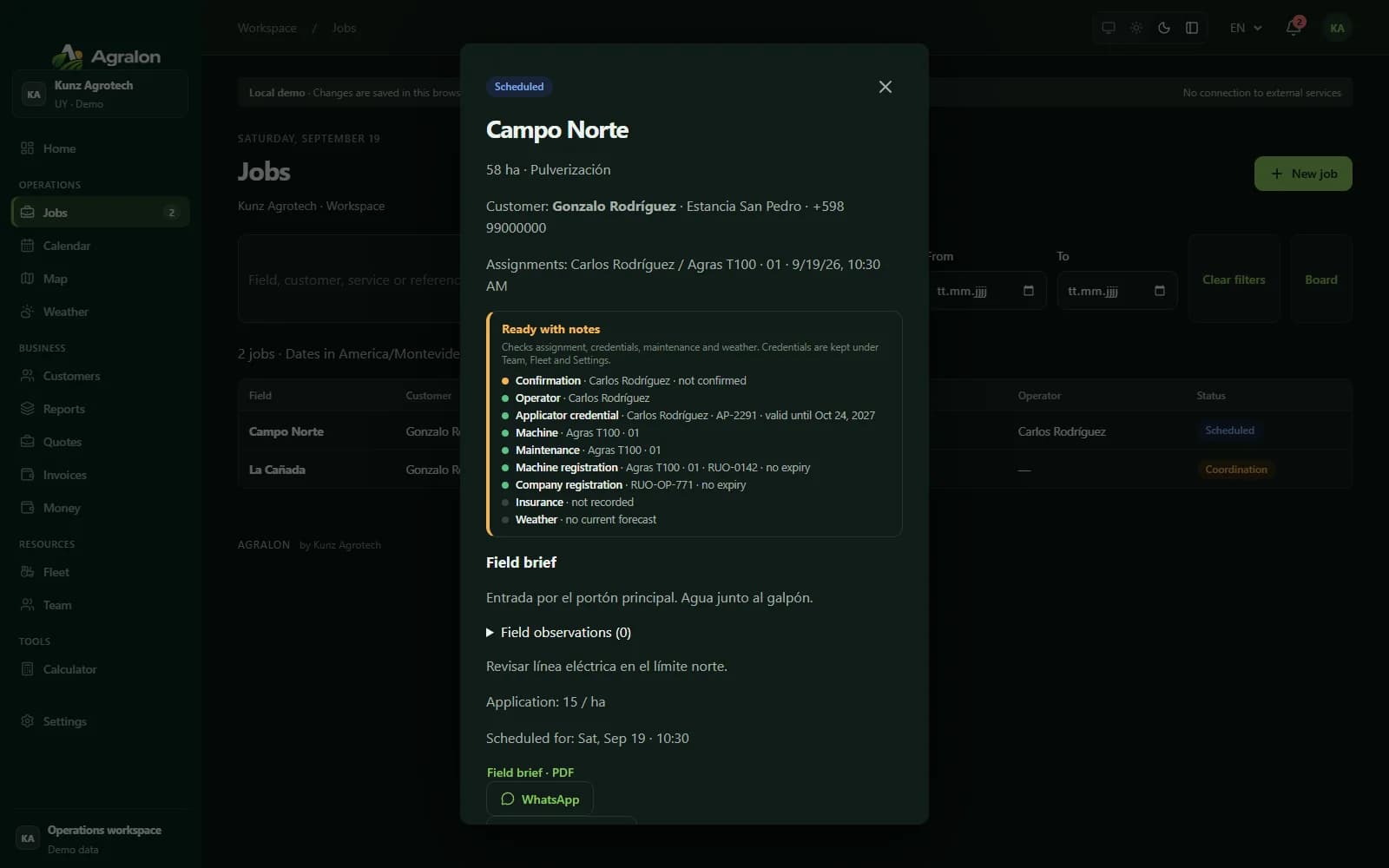
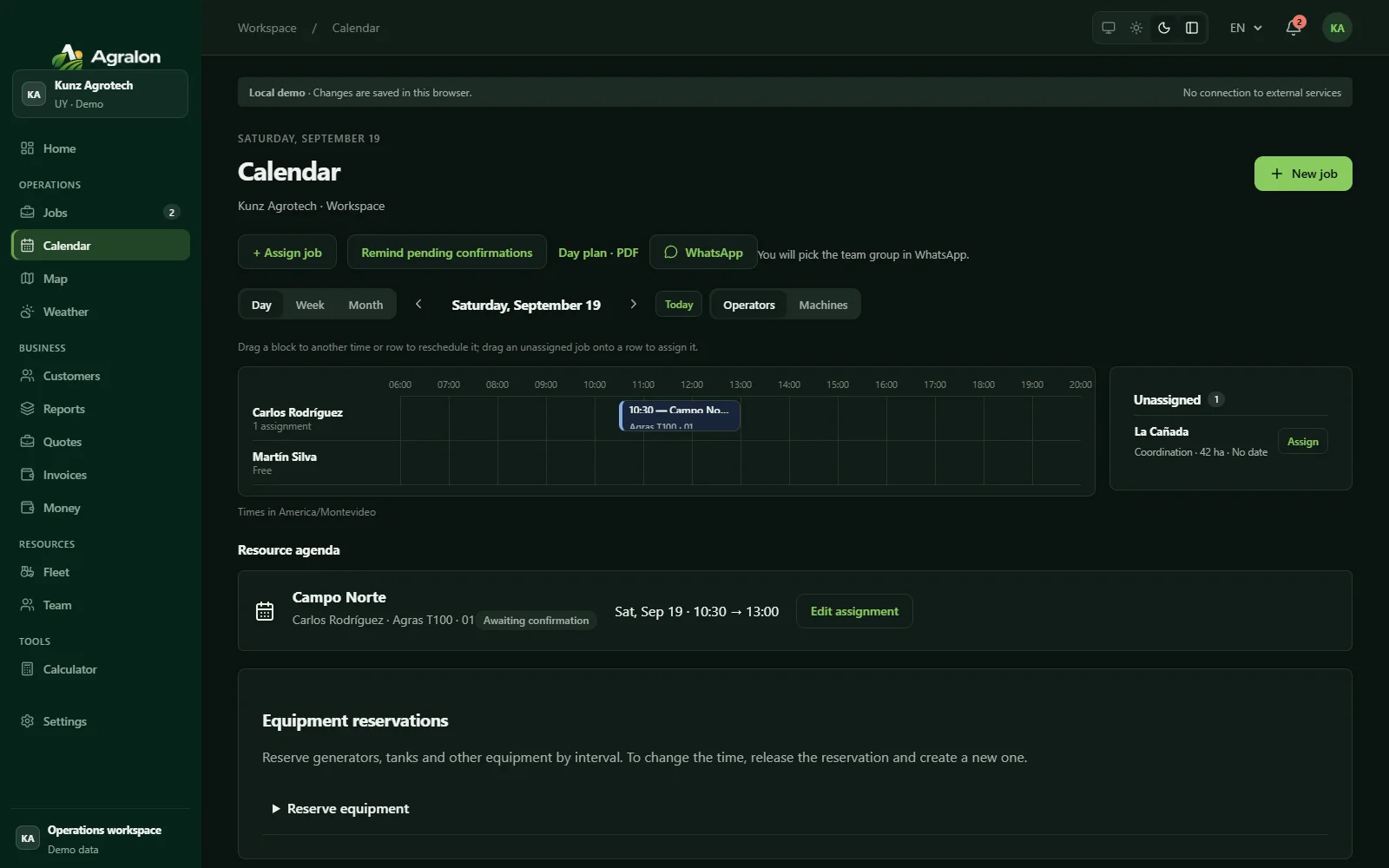
The web workspace gives owners a daily overview, a dispatch calendar, customers, fields with boundaries on a map, fleet and team, quotes, reports, invoices and finances.
The mobile app guides pilots through the day with exactly one next step: open the job, check the conditions, start, pause, refill, finish, document. Documents — field briefs, work reports, invoices, statements — are generated as PDFs from live data, in the customer's language.
05 / Core system
Modules that share one source of truth.
Each module is useful by itself; together they remove the re-typing between them.
- Customers, farms and fields with map boundaries
- Jobs with status workflow and assignments
- Dispatch calendar by pilot and machine
- Fleet, usage and maintenance
- Weather conditions per field and time window
- Products, mixes and a spray calculator
- Reports, quotes, invoices and payments
- Credentials and compliance records
06 / Experience
Designed for a tractor cab, not a conference room.
The interface follows its own design system with light and dark modes, large touch targets and a calm, legible hierarchy that holds up in sunlight. The field app speaks plainly and always answers one question: what do I do next?
Agralon is available in Spanish, Portuguese, English and German, with documents and messages following the customer's language.
07 / Engineering
Offline-first in the field, strict on the server.
Field events are queued on the device with idempotent operations and synchronized when the connection returns; conflicts stay visible instead of being silently dropped. On the server, PostgreSQL with row-level security makes the database — not the interface — the authority on who may see and change what.
- Next.js and React web workspace
- React Native (Expo) mobile app with local SQLite
- PostgreSQL with PostGIS and row-level security
- Server-side PDF generation
- Provider-independent maps and weather data
- Automated tests for workflow, permissions and sync
- Backup, restore and audit tooling
08 / Impact
From scattered messages to one operating picture.
Agralon is in production and being tested with operators. We don't publish numbers we can't stand behind; what the system changes is structural.
- Centralized workflows from inquiry to payment
- Improved operational visibility for owners
- Reduced manual steps for reports and invoices
- Clear guidance for pilots in the field
- A structure that scales from one drone to a fleet
Have a problem technology could solve?